Semantic Generative Tuning
for Unified Multimodal Models
The first systematic investigation into generative post-training for UMMs — bridging visual understanding and generation through high-level semantic proxies.
1Shanghai Jiao Tong University 2Tencent ARC Lab
(BAGEL baseline)
samples (SAM)
validated
Unified multimodal models (UMMs) strive to consolidate visual understanding and visual generation
within a single architecture. However, prevailing training paradigms independently optimize understanding
via sparse text signals and generation through dense pixel objectives.
Such a decoupled strategy yields misaligned representation spaces, isolating visual understanding
from generation and hindering their mutual reinforcement.
This work presents the first systematic investigation into generative post-training,
where we formulate hierarchical visual tasks as generative proxies to bridge the isolation in UMMs.
Our empirical investigation reveals that high-level semantic tasks, particularly image segmentation,
serve as optimal proxies. Unlike low-level tasks that distract models with texture details,
segmentation provides structural semantics that significantly enhance both vision-centric perception
and generative layout fidelity.
Building upon these insights, we introduce Semantic Generative Tuning (SGT),
a novel paradigm that leverages segmentation as a generative proxy to align and synergize
multimodal capabilities. Extensive evaluations show that SGT consistently improves both
multimodal comprehension and generative fidelity, achieving a
6.02% gain on CV-Bench over BAGEL and a 90.0% score on GenEval.
We compare three paradigms for training unified multimodal models and pinpoint the critical gap.
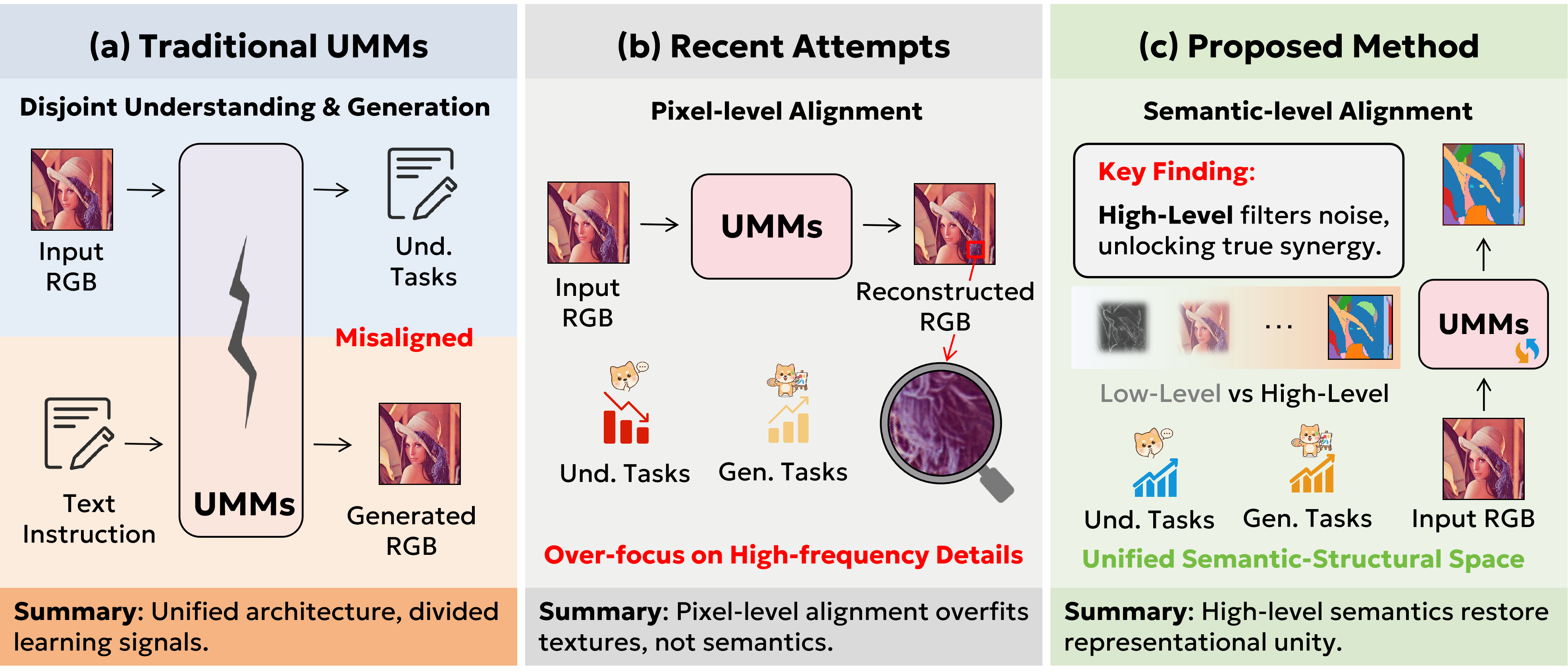
Traditional UMMs
Understanding and generation are optimized independently with divergent supervisory signals, resulting in misaligned representations and no synergy between the two capabilities.
MisalignedPixel-Level Alignment
Recent methods use pixel-space reconstruction as a proxy. While yielding some gains, this over-emphasizes textures and distracts from semantic reasoning.
SuboptimalSemantic Generative Tuning
SGT leverages image segmentation as a generative proxy — high-level semantic structure that naturally bridges understanding and generation through shared semantic space.
Optimal ✓SGT formulates image segmentation as a generative post-training objective within UMMs.
The framework is architecture-agnostic and validated across two fundamentally different UMM designs.
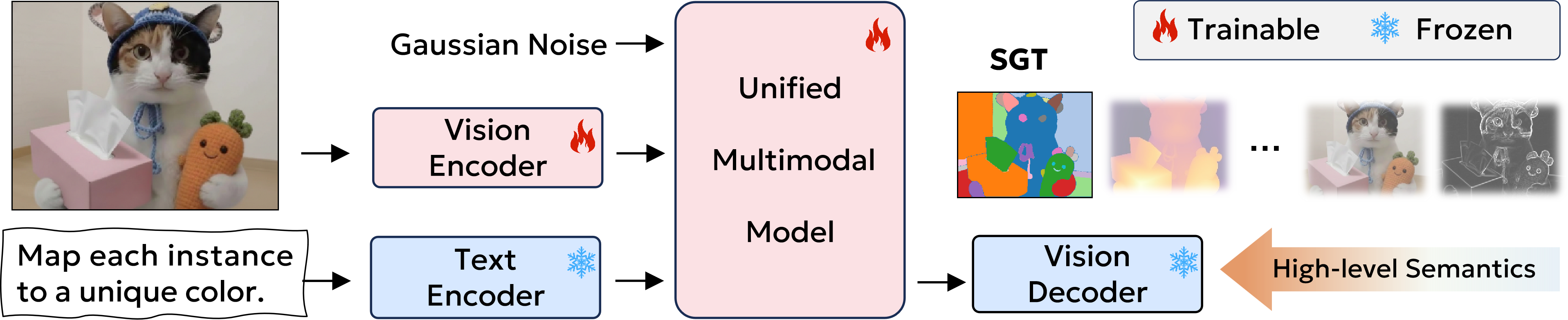
BAGEL (7B + 7B)
- Highly native design. Mixture of Transformers with native interleaved training across understanding and generation.
- Shared attention. Understanding and generation streams interact through shared attention, enabling deep cross-modal fusion.
- Larger scale. Dual-7B parameter capacity provides strong representational power for SGT integration.
OmniGen2 (3B + 4B)
- Frozen VLM. The pretrained VLM is kept frozen; only the diffusion head is trained.
- Feature sharing. Hidden states are shared as semantic guidance, bridging understanding and generation in series.
- Lightweight parameters. Compact 3B + 4B configuration delivers efficient training and inference.
Our hierarchical task study across BAGEL and OmniGen2 reveals consistent patterns guiding SGT's design.
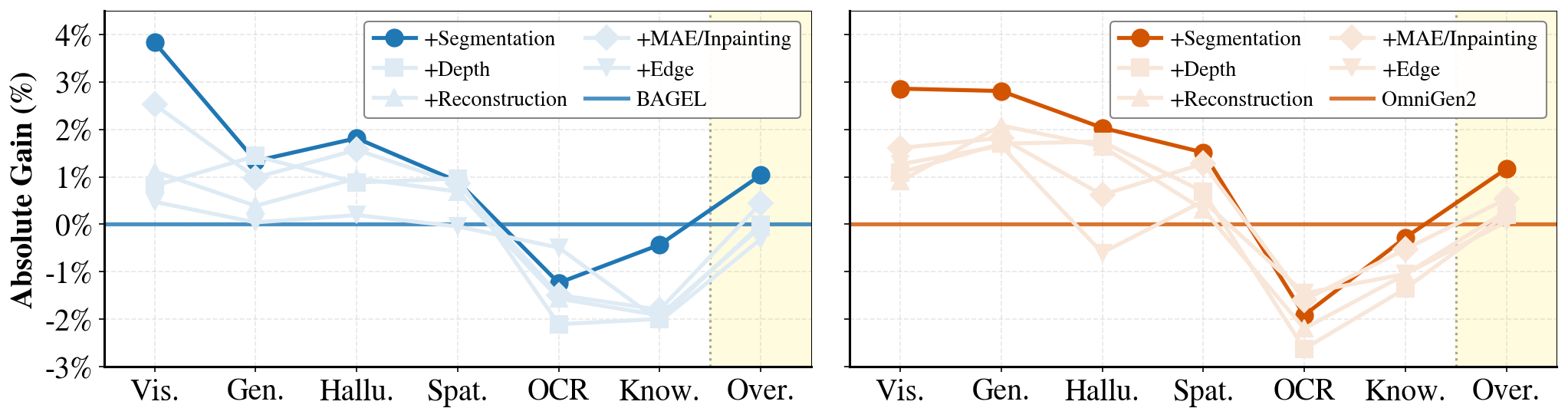
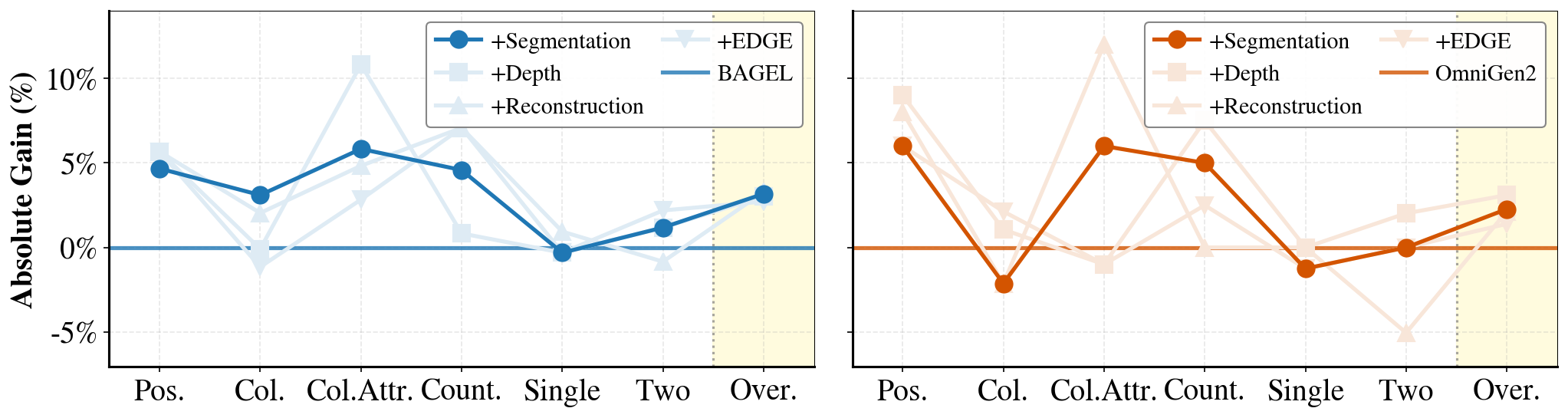
High-level semantic tasks dominate
Image segmentation consistently outperforms mid-level (depth estimation) and low-level (edge detection) tasks on all understanding benchmarks. High-level supervision aligns with perception demands, while texture-focused tasks cause overfitting to irrelevant details.
High-level winsVisual supervision enhances perception, not reasoning
Generative tuning fortifies visual perception (vision-centric tasks, spatial reasoning, hallucination resistance) while chart/math reasoning remains static. Visual supervision enhances representation quality but does not impart logical priors.
Perception onlySpatial fidelity improves universally
Regardless of semantic granularity, all proxy tasks consistently improve generative spatial fidelity — especially for position-aware tasks. Reconstructing visual structure forces accurate spatial layouts, naturally boosting positional prompt adherence.
Universal gainSGT consistently outperform their baselines and surpass competitive UMMs across understanding and generation benchmarks.
| Model | Params | Visual Understanding | Visual Generation | ||||||
|---|---|---|---|---|---|---|---|---|---|
| MMVP↑ | VSR↑ | Hallu.↑ | MMStar↑ | RWQA↑ | MathV.↑ | GenEval↑ | GEdit↑ | ||
| Small-scale Models (≤ 4B) | |||||||||
| Show-o 512 | 1.3B | 50.00 | 54.26 | 46.06 | – | 38.17 | – | 68.0 | ✗ |
| Harmon | 1.5B | 60.00 | 60.88 | 46.69 | 38.00 | 48.00 | 33.70 | 73.0 | ✗ |
| UniLIP | 2B | 73.00 | 65.55 | 60.57 | – | 64.18 | – | 90.0 | – |
| UniMRG | 3.6B | 74.67 | 73.90 | 64.56 | – | 66.01 | – | 55.8 | ✗ |
| OpenUni | 2B | 71.67 | 66.69 | 60.88 | – | 65.23 | – | 51.0 | – |
| OmniGen2 | 3B+4B | 65.00 | 77.52 | 62.35 | 55.07 | 64.41 | 63.50 | 76.0 | 6.63 |
| ✦ SGT-Gen2 (Ours) | 3B+4B | 68.33 | 78.85 | 64.25 | 57.07 | 65.10 | 64.00 | 79.1 | 6.83 |
| Large-scale Models (≥ 7B) | |||||||||
| Chameleon | 7B | 50.00 | – | 31.13 | 28.93 | 39.00 | 21.90 | 39.0 | ✗ |
| Janus-Pro | 7B | 63.00 | 71.03 | 60.15 | 46.80 | 41.83 | 42.60 | 80.0 | ✗ |
| UniWorld-v1 | 7B+12B | 77.67 | 83.34 | 68.35 | 63.90 | 67.58 | 68.20 | 84.0 | 4.85 |
| BAGEL | 7B+7B | 83.00 | 80.45 | 68.34 | 67.46 | 71.26 | 73.10 | 88.0 | 6.64 |
| ✦ SGT-BAGEL (Ours) | 7B+7B | 83.33 | 81.54 | 70.24 | 68.33 | 72.42 | 73.90 | 90.0 | 6.94 |
SGT yields the largest gains across understanding benchmarks while achieving competitive generation performance.
| Method | CV-Bench↑ | MMVP↑ | VSR↑ | SIBench↑ | POPE↑ | Hallusion↑ | GenEval↑ | GEdit↑ |
|---|---|---|---|---|---|---|---|---|
| Base: BAGEL | ||||||||
| BAGEL (Base) | 73.21 | 83.00 | 80.45 | 48.95 | 85.69 | 68.34 | 78.21 | 6.52 |
| + SFT only | 74.61 | 82.67 | 80.69 | 49.34 | 86.77 | 67.92 | 77.18 | 6.49 |
| + SFT + Edge | 74.56 | 83.67 | 80.83 | 49.51 | 86.48 | 68.66 | 79.96 | 6.72 |
| + SFT + Reconstruction | 75.23 | 83.33 | 80.83 | 50.59 | 87.98 | 68.03 | 80.82 | 6.75 |
| ✦ + SFT + SGT (Ours) | 79.23 | 83.33 | 81.54 | 50.18 | 88.32 | 70.24 | 80.95 | 6.94 |
| Base: OmniGen2 | ||||||||
| OmniGen2 (Base) | 65.94 | 65.00 | 77.52 | 43.29 | 85.97 | 62.35 | 76.58 | 6.63 |
| + SFT only | 65.99 | 66.00 | 77.61 | 44.37 | 86.25 | 64.35 | 74.54 | 6.32 |
| + SFT + Edge | 66.67 | 65.33 | 77.99 | 45.51 | 86.10 | 63.72 | 77.45 | 6.79 |
| + SFT + Reconstruction | 66.71 | 66.33 | 78.18 | 45.41 | 85.92 | 65.19 | 77.53 | 6.81 |
| ✦ + SFT + SGT (Ours) | 66.91 | 68.33 | 78.85 | 45.37 | 87.29 | 64.25 | 78.86 | 6.83 |
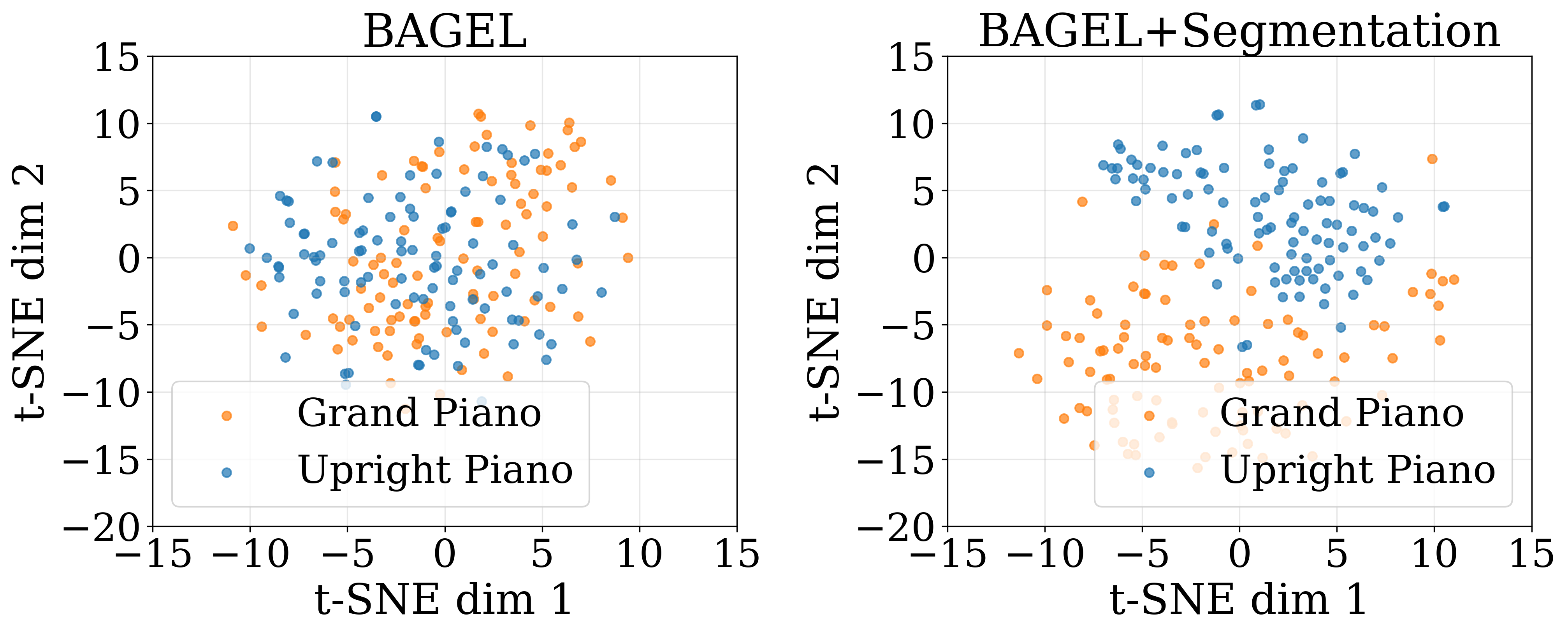
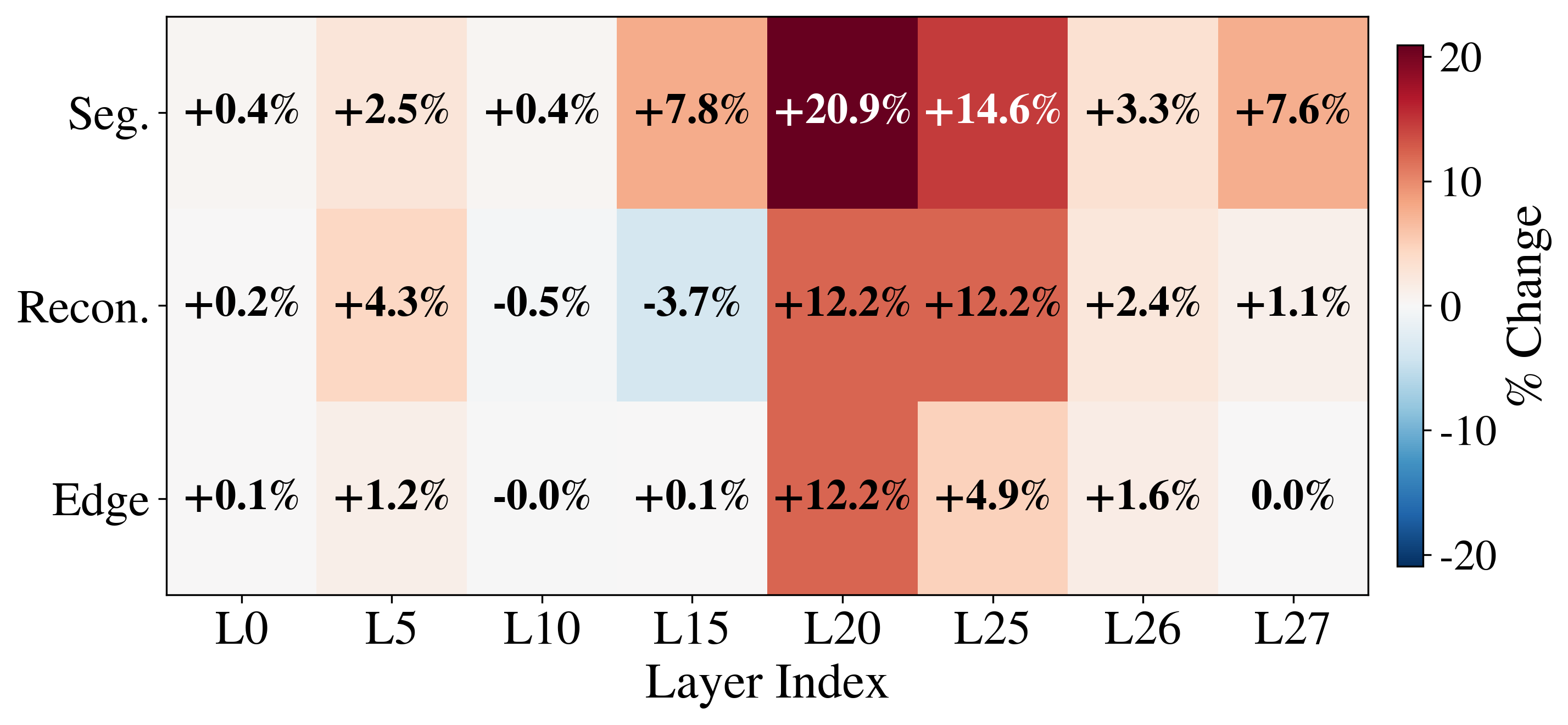
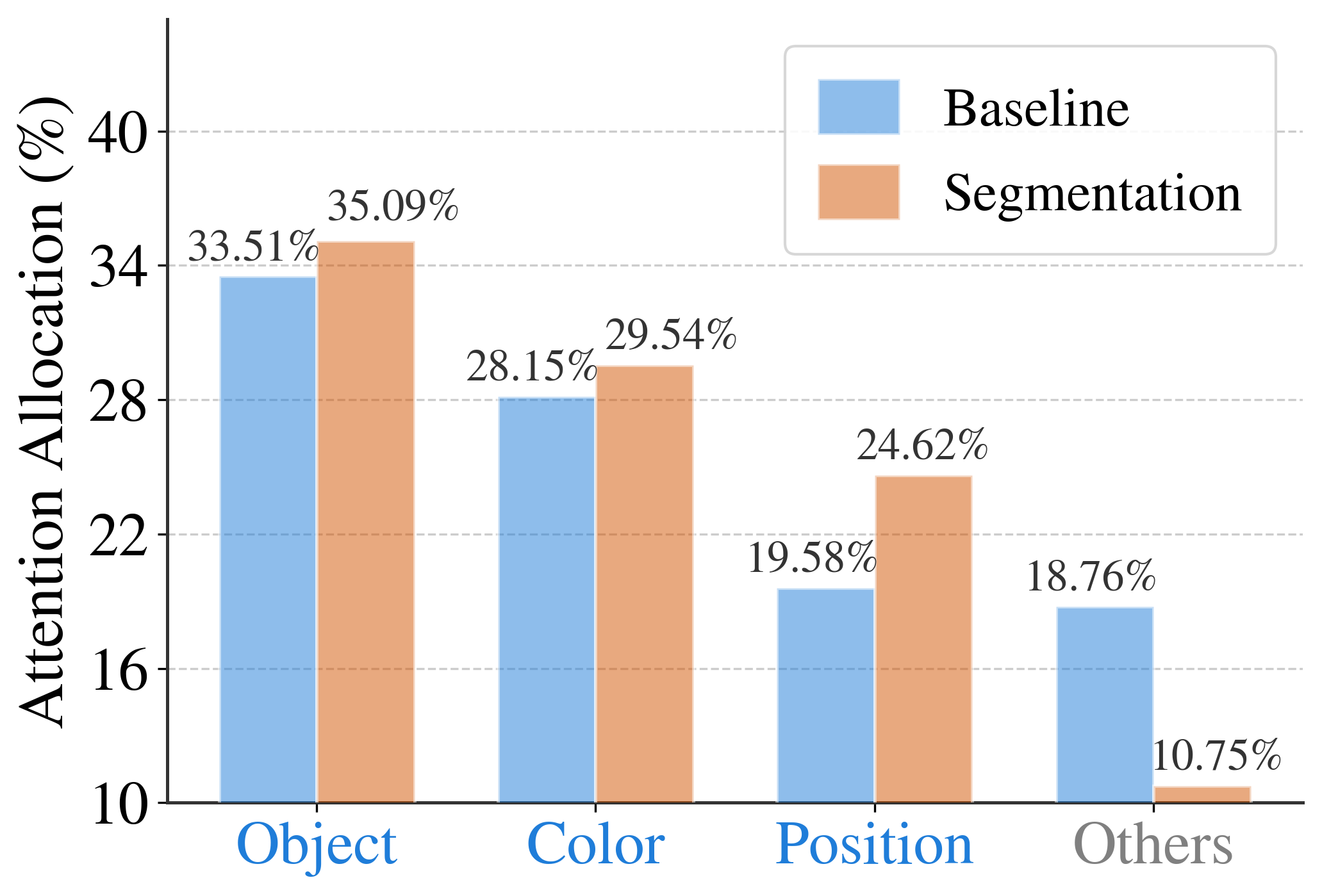
We probe feature distributions and attention dynamics to uncover the mechanisms behind SGT's improvements.
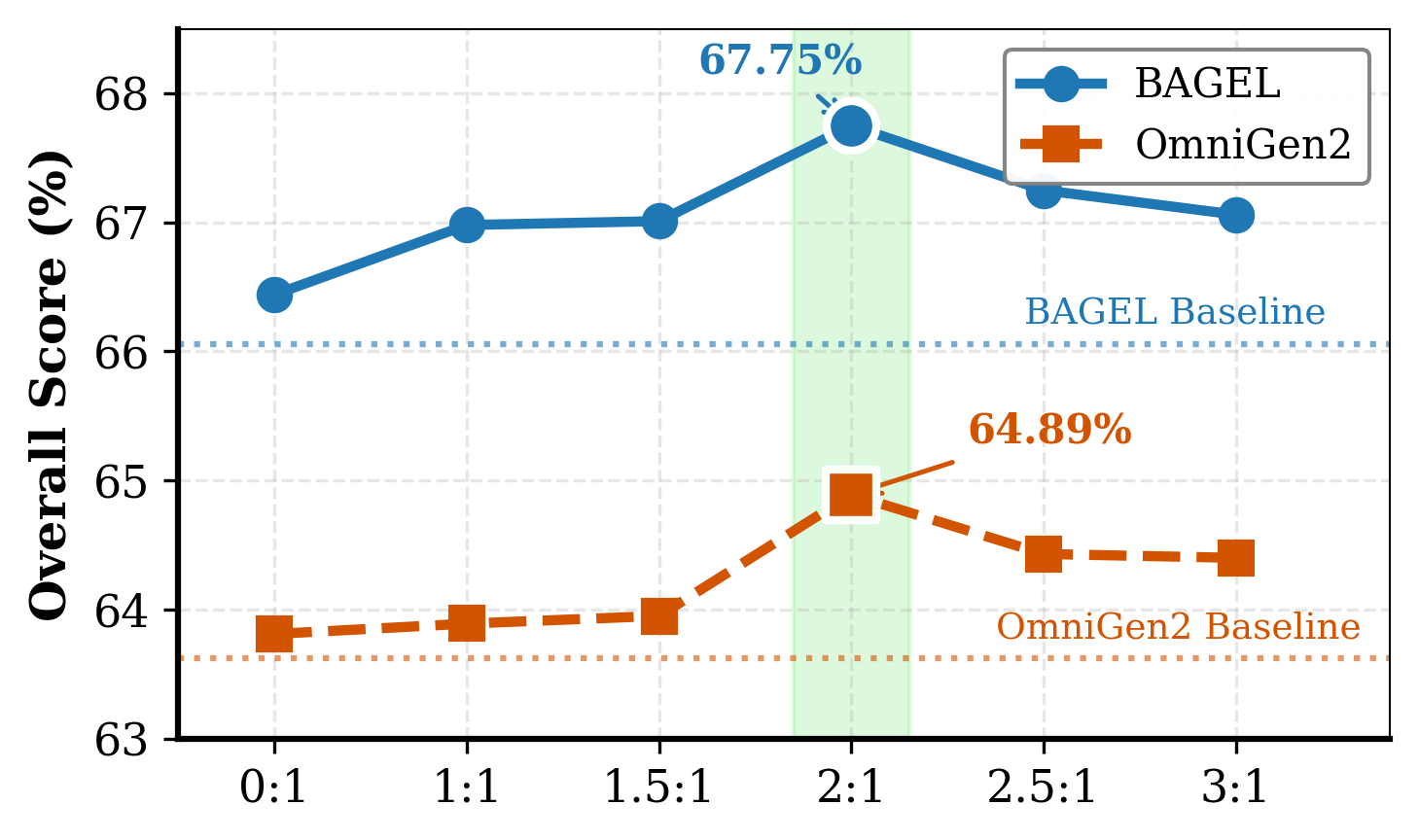
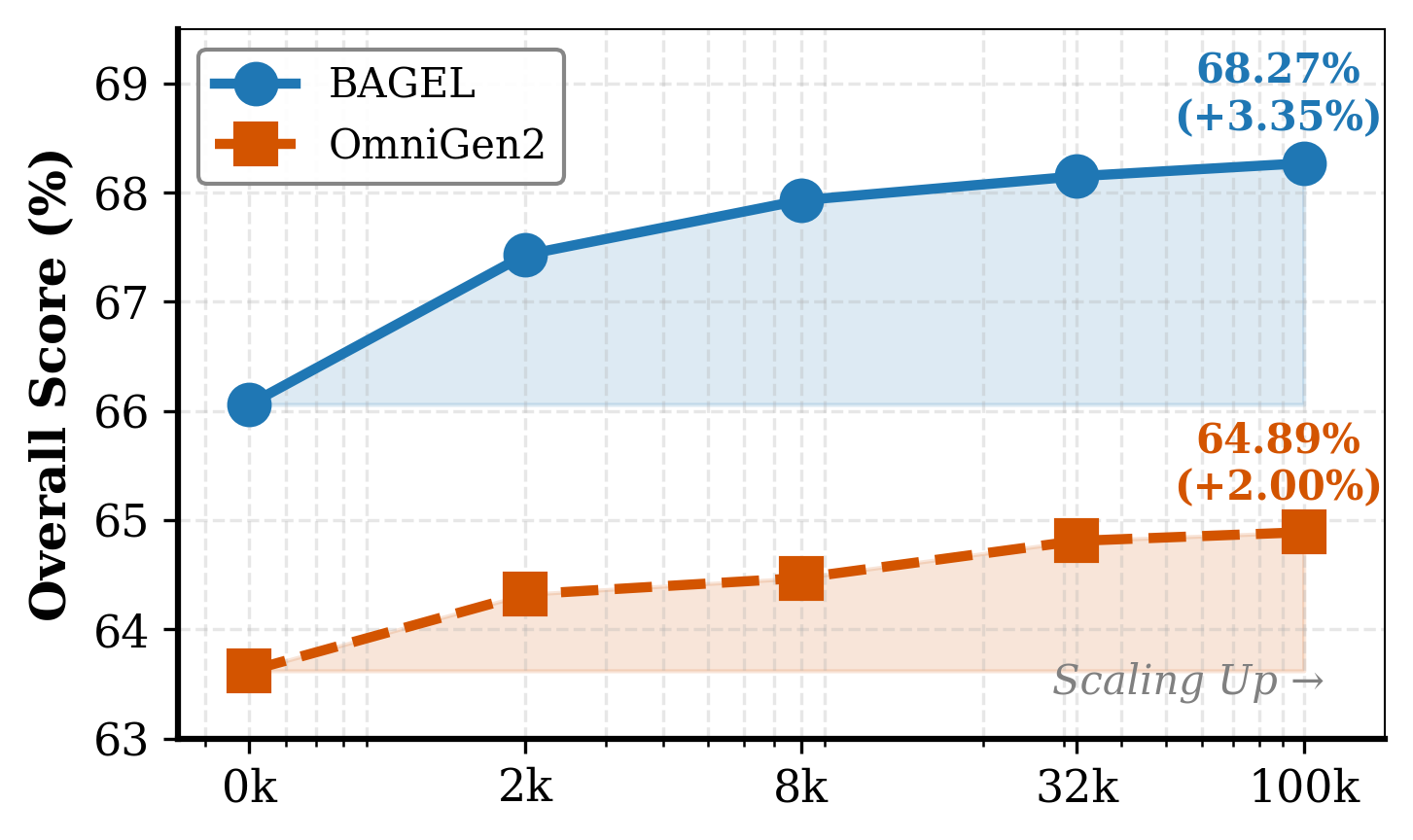
SGT is scalable — performance improves with more segmentation data, and a 2:1 Seg:VQA batch ratio is optimal.
If you find SGT useful in your research, please consider citing our work.
@article{yu2026sgt,
  title     = {Semantic Generative Tuning for Unified Multimodal Models},
  author    = {Yu, Songsong and Chen, Yuxin and Shan, Ying and Li, Yanwei},
  journal   = {arXiv preprint arXiv:2605.18714},
  year      = {2026},
}